
If you’ve been building APIs for any length of time, the mere mention of SOAP will trigger one of two things: a wave of genuine nostalgia or a mild, involuntary stress tic. For many of us who cut our teeth in the early 2000s, SOAP wasn’t optional—it was the standard. It quietly powered everything from global banking infrastructure to military defense systems – where i had the misfortune to work wioth it. If you needed two machines to chat over HTTP and wanted the communication to feel officially Enterprise-Grade, you used SOAP.
I was recently reminded of all this when a client innocently asked, “Do you still work with SOAP APIs?” The question instantly yanked me down memory lane and showed me just how drastically the industry has changed.
What SOAP Actually Was
SOAP wasn’t just an API format; it was a total worldview.
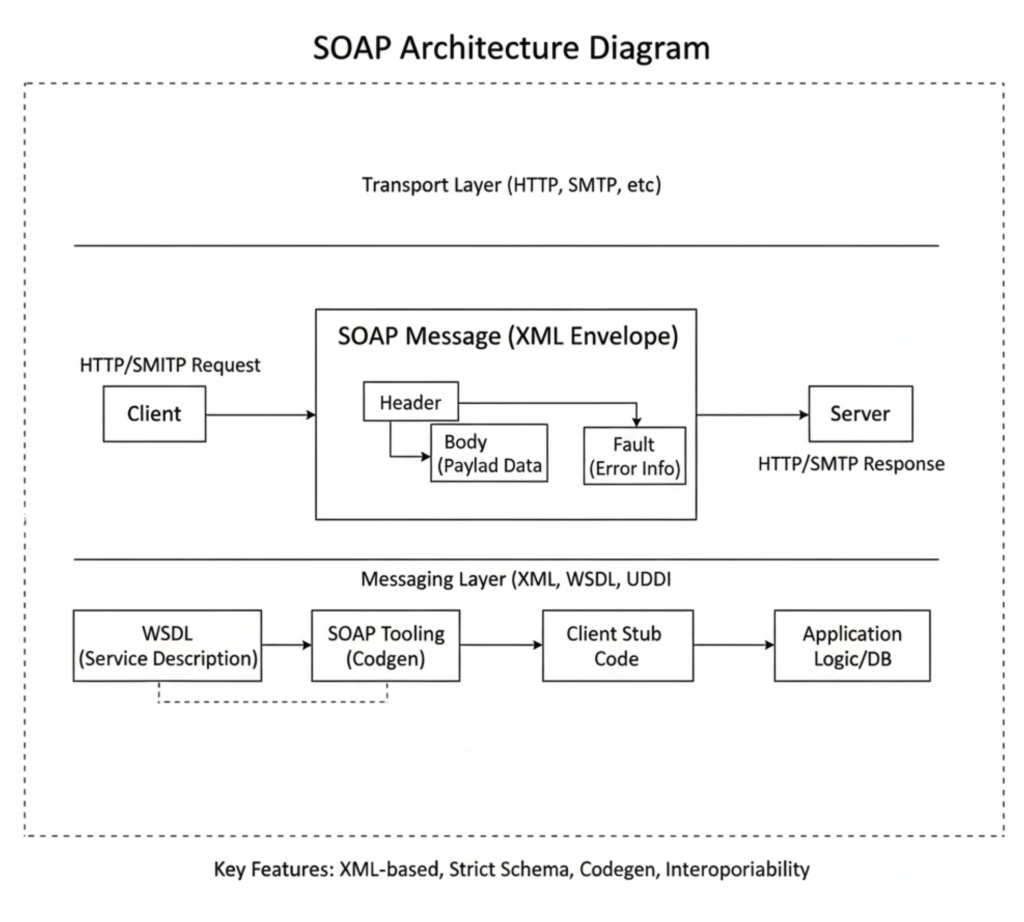
The core premise was that the only correct way to build distributed systems was to simply recreate enterprise application architecture, but over the network wire. This meant absolute definition, documentation, and enforcement: a schema for everything, a namespace for everything, and a WSDL (Web Services Description Language) to describe it all. Every single request was wrapped in an XML envelope large enough to smuggle a small dog.
SOAP’s pitch was seductive: strictness equals guaranteed interoperability. By forcing everyone into formal, rigid contracts, you were supposed to eliminate all ambiguity, implicit behavior, and surprises. And to be fair, that discipline had benefits. It encouraged clear documentation, typing, and predictability back when the internet was still the Wild West.
What Working With SOAP Was Actually Like
Then came the grind.
Using SOAP meant constantly wrestling with enormous XML payloads, wrestling with vendor-specific WSDL eccentricities, being beholden to fragile toolchains that generated half your application’s boilerplate, and spending hours trying to decipher error messages that seemed written in ancient Aramaic.
In sectors like defense I used it in, and government, SOAP was gospel because it felt robust. You weren’t just sending data; you were executing a formal agreement between two sovereign API states. Every request felt like a treaty negotiation.
Debugging was a special form of hell. Mis-nest one tag? Nothing works. The client and server disagree on a namespace prefix? Everything breaks. Your code generator updated itself? You might as well restart the project. It was verbose, unbelievably brittle, and notoriously good at hiding crucial implementation details.
What Replaced It
The one-word answer is REST. (Or more precisely REST-ish)
REST won because it stopped fighting the internet. It embraced the web’s native simplicity: clear HTTP verbs, simple resources, human-readable payloads, and flexibility over rigidity. JSON decisively beat XML because developers could actually read it without needing an aspirin first. HTTP became a straightforward transport layer instead of an RPC tunnel wearing a complicated disguise.
Since then, we’ve moved even further with tools like GraphQL, gRPC, event-driven APIs, and Webhooks. Each new standard has moved us further away from SOAP’s oppressive weight and toward something faster, more adaptable, and infinitely more accessible.
The Lessons SOAP Taught Us
It wasn’t all bad. SOAP forced the industry to learn some painful, but valuable, lessons:
- Contracts matter. When REST first arrived, the web swung hard toward “YOLO APIs.” Teams ditched all schema discipline and quickly reinvented the worst parts of SOAP through undocumented chaos. That’s why OpenAPI and JSON Schema are non-negotiable today.
- Tooling matters. SOAP relied heavily on code generation, and while the execution was often terrible, the core idea was sound. Great developer experience doesn’t just come from good specs, it comes from powerful, useful tools.
- Consistency matters. SOAP intentionally abhorred ambiguity. Modern API design is finally rediscovering that strict consistency across endpoints isn’t just nice—it’s a competitive advantage.
- Siloed industries move slow. Defense, government, banking, and healthcare clung to SOAP for years after it became obsolete. You can still spot today’s equivalent—sectors that refuse to adopt modern identity standards or insist on using CSV file uploads. They never learned the lesson.
Why SOAP Still Haunts Us
You still run into SOAP today for a handful of reasons:
- Ancient, mission-critical legacy systems.
- Massive, inertia-driven enterprises.
- Vendors who haven’t touched their integration stack since 2005.
- Anything built by a contractor who billed by the line of XML.
The irony is thick: SOAP’s incredible strictness is the very thing that keeps it alive. The systems it underpins are too business-critical to rebuild, and because the contracts are so brittle, once something is working, no one wants to be the one to touch it.
Our Final Verdict
In retrospect, SOAP was the ultimate case study in over-engineering. The intentions were good—who doesn’t want predictable systems?—but the result was a framework so rigid that the smallest deviation caused catastrophic failure.
When REST arrived, the collective industry let out a huge sigh of relief and never looked back.
The main takeaways:
- Over-engineering creates fragility, not robustness.
- Developers will always choose the simplest tool that actually solves the problem.
- True interoperability comes from shared, light-weight conventions, not heavy frameworks.
- If your API requires a generator tool, proprietary documentation, and a schema professor just to understand the most basic request, you’ve already failed.
And Yet, Here We Are
Twenty years later, I still occasionally get the fateful question: “Can you integrate with a SOAP API?”
Yes. We can. We’ve done it enough times. But every time it happens, it’s a stark reminder of how far we’ve traveled.
We now live in a world of fast-moving, well-documented, human-friendly APIs. We have JSON instead of XML. OpenAPI instead of WSDL. Schema evolution instead of schema paralysis. Lightweight integration instead of crushing ceremony.
In the end, SOAP took the beating so the rest of us could run.
Recent Posts
-
 We’ve Given Away Thousands of Dollars Celebrating the Developers Building With TheDogAPIMarch 7, 2026
 -
 We brought a clients BigQuery bill down by over 50% by implementing one thing, here’s the code for free.December 10, 2025
 -
 SOAP: A Look Back At The API Standard That Defined A Generation (And Drove Me Mad)November 20, 2025